Am I what I eat?
.webp)
Everyone of you has heard the saying “You are what you eat.” But is that really true? We want to get to the bottom of the mystery and bring you closer to your view of food and its power over our health.
In short:
- Nutrition plays an essential role for our body and mind
- Everyone is different — there is no uniform diet for everyone
- Develop a positive attitude towards food that promotes your wellbeing!
Our body is a complex machine that requires a variety of nutrients to function. These nutrients fall into two main categories: macronutrients and micronutrients. Macronutrients include carbohydrates, proteins, and fats. These are essential for our body, as they provide energy and serve as building blocks for various metabolic processes. Carbohydrates and fats are primarily sources of energy that help us manage our daily activities. Proteins, on the other hand, not only provide energy, but are also crucial for building and maintaining our muscles, as they contain amino acids that are important for energy metabolism and muscle regeneration.
But what about all the vitamins? What's up with them?
In addition to macronutrients, humans also need an entire arsenal of micronutrients to function. Vitamins and minerals are essential for the body. This means that our body cannot synthesize many of these substances itself. So we have to get them from our diet. Otherwise, there may be many health problems. Vitamins are involved in almost all metabolic processes. They strengthen the immune system, build bones and teeth and are important for blood formation and cell division. Balancing these nutrients is critical to keeping our bodies healthy, optimizing energy production, and maximizing physical performance.
Protection against illness
What ends up on our plate can be decisive for our health — it can both benefit and harm us. The Harvard School of Public Health emphasizes that a balanced diet is central to health promotion and disease prevention. Research shows that a diet that includes plenty of fruits, vegetables, and whole grains can reduce the risk of cardiovascular disease, type 2 diabetes, and some types of cancer. In contrast, the “western diet,” which is associated with a high consumption of highly processed high-calorie foods, is associated with an increased risk of these health problems. In hectic times, we often use such quick meals, which increases the problem. Excessive sugar consumption in particular is a known risk factor for various health problems.
But hold on to the forks — there's more!
Food for the head
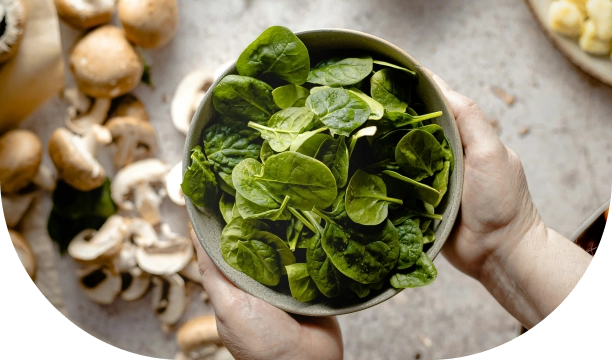
Our eating habits have a huge impact on our mental functions. Food intake affects not only our bodies, but also our emotions and mental health. Omega-3 fatty acids and B vitamins can positively influence our gray cells and mood. One in four people in Germany is affected by a mental illness such as depression or anxiety disorder. There are indices in science that your eating habits can influence your psyche. A study from 2017 claims that a healthy diet has an alleviating effect on depression and anxiety.
The personal puzzle
So why isn't there a uniform diet plan for everyone? The answer is simple: every person is unique. What works for one person may not be right for another. Age, lifestyle, genetic predispositions and much more play a role in determining our ideal diet. Personalized diet plans aren't just a trend, they're a necessity for real health success.
So what now?
Yes, in a way, we are what we eat. But it's not just about blindly avoiding or consuming certain foods. It's about developing a conscious relationship with food that promotes our health, wellbeing and zest for life.
Experiment, have fun and find out what is good for your body and soul. Develop a healthy eating pattern Because at the end of the day, the key to a healthier, happier life could lie in exactly what we eat.
Where do I start?
Here are the 10 rules of the German Nutrition Society. These serve as a solid basis for integrating a balanced and diverse diet into your everyday life:
The DGE's 10 rules for a healthy diet:
- Enjoy a variety of foods
- Vegetables and fruits - Take 5 a day
- Choose whole grains
- Supplement with animal foods
- Use health-promoting fats, such as vegetable oils
- Save sugar and salt
- It's best to just drink water
- Prepare food gently
- Take your time and eat without distractions
- Watch your weight and stay active

sources:
- Ebermann R. (2011): Food Chemistry and Nutrition Textbook
- Harvard T.H. Chan, School of Public Health: The basics of a healthy diet. Accessed on 19.02.2024 https://www.hsph.harvard.edu/nutritionsource/nutrition-and-immunity/
- World Health Organization: Healthy Diet Fact Sheet. Accessed 19.02.2024 https://www.who.int/news-room/fact-sheets/detail/healthy-diet
- Owen, L. & Corfe, B. (2017) The role of diet and nutrition on mental health and wellbeing. Accessed on 19.02.2024 https://pubmed.ncbi.nlm.nih.gov/28707609/


.webp)