Sustainability and responsibility at Foodji

Felix Munte und Daniel von Canal für Foodjis Nachhaltigkeit

“Sustainability is a fundamental part of our DNA and plays an important role in every decision we make.”

Felix Munte & Daniel von Canal
Founder and Chief Executive Officer at Foodji
Our principles

Sustainability as the basis for our actions

In all our operational areas, we focus on sustainable implementation and continuous optimisation of our processes. Sustainability is the basis of everything we do. Above all, the UN Sustainable Development Goals are present at Foodji and are an integral part of our sustainability agenda.

Our supply chain
OUR SUPPLY CHAIN

Every step of the supply chain counts.

problem

Germany produces 11 million tonnes of food waste every year.

Of this, 17% is in out-of-home catering and 59% in private households. In company catering, at least 30% of products are regularly thrown away.

Source: Bundesregierung.de
Solution: Intelligent AI planning

How does Foodji actively contribute to preventing food waste?

Intelligente Planung bei Foodji
No overstocking thanks to intelligent quantity planning

95% of our guests use the Foodji app. This allows us to understand the demand behaviour and preferences of each individual Foodji location. Machine learning and algorithms help us to use this data to plan a tailor-made product range for each location and to continuously optimise it: intelligent quantity planning allows us to avoid overstocking.

0% food waste in Berlin

We work with voluntary organisations to distribute leftover meals – donating rather than wasting.

Nachhaltiger Konsum und Produktion

Nachhaltiger Konsum und nachhaltige Produktion sind bei Foodji eng mit innovativer Technologie verknüpft - als Basis für einen verbesserten Umgang mit Ressourcen.

problem

Support for the regional economy is being lost.

Without cooperation with sustainable and regional partners, companies risk not only ecological but also social consequences. Not forming local partnerships leads to longer transport routes, increased CO2 emissions and greater environmental impact. In addition, support for regional economies is lost, which can affect the diversity and resilience of communities.

Solution: Our partners

Active expansion of product range with sustainable, regional partners

Leckeres Foodji gericht von Partnern
BettaF!sh

With BettaF!sh as our partner, we can offer our guests delicious tuna alternatives and expand our plant-based range, which is good for us and the oceans.

Planted

Planted manufactures plant-based meat substitutes. Thanks to this collaboration, we have been able to expand our range with many fresh and delicious vegan dishes such as Planted Butter Chicken.

Lemonaid

Lemonaid's fresh organic lemonades support fair trade and promote local projects with every bottle sold. Lemonaid has been awarded Fairtrade certification for this.

Foodji bietet bsplw. Fisch

We carefully select our partners and promote vegetarian and vegan alternatives in our product portfolio.

Problemstellung

Mehrwegbehälter - ein langer Weg zur Nachhaltigkeit

Mehrwegsysteme gehen mit einem hohen Aufwand für Logistik und Reinigung der Behältnisse einher und sind vor allem dort sinnvoll, wo große Mengen an Mehrwegbehältern zusammen transportiert, gereinigt und ins System zurückgeführt werden können. Mindestens 8 mal muss ein Mehrwegbehälter genutzt werden, damit es sich lohnt.

Quelle: Lifeverde.de
Solution: Our packaging

Recyclable disposable packaging

Foodjis recyclebare Verpackung
Continuous evaluation of our packaging

We are continuously expanding our measures to optimise our contribution to sustainability, but so far we see the most positive results in our current packaging approach. Nevertheless, we will continue to evaluate our options for offering reusable packaging.

Up to 90% less plastic film for optimum hygiene and shelf life
Simple and effective waste separation
Nachhaltiger Konsum und Produktion

At Foodji, sustainable consumption and production are closely linked to innovative technology – as the basis for improved resource management.

problem

Detours through intermediaries

Many restaurants are forced to use several intermediaries or delivery services. This creates a complex supply chain with long transport distances.

Solution: Delivery route & filling

Our supply chain – optimised from preparation to guest

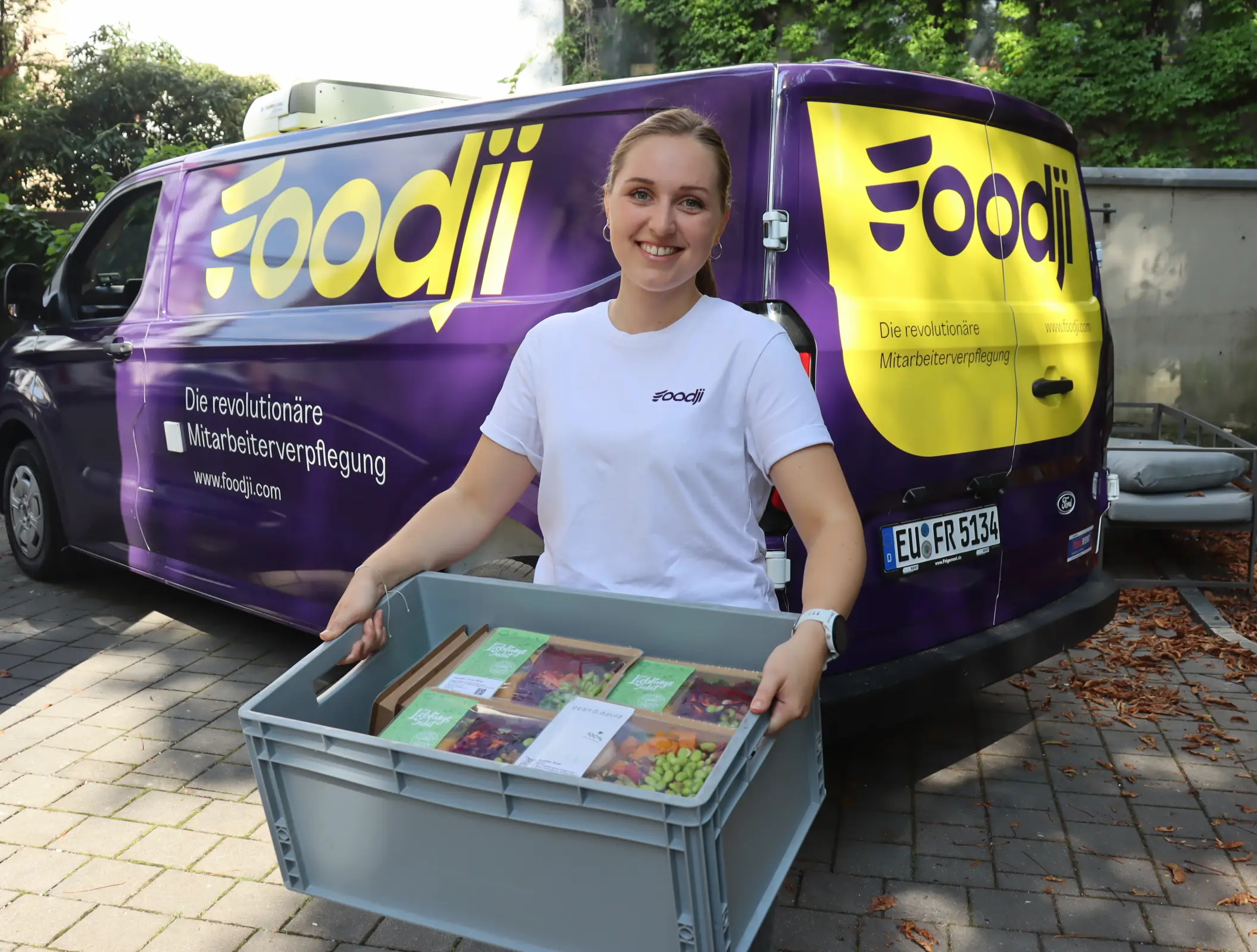
Laura in front of the Foodji car
Regional sourcing of resources

Our factories produce exclusively in Germany, always in the locations where most of the resources are grown. This enables us to achieve our goal of sourcing as many ingredients as possible from the region.

Approximately 9 km driving distance between the locations

Within a hub, the distance between individual locations is approximately 9 km. This distance will continue to decrease as the number of Foodjis steadily grows.

Foodji vermeidet lange Lieferwege

At Foodji, an optimised supply chain and sustainable production are closely linked to innovative technology – we want to build a sustainable infrastructure.

problem

Germany produces 11 million tonnes of food waste every year.

Of this, 17% is in out-of-home catering and 59% in private households.* In company catering, at least 30% of products are regularly thrown away.

Source: Bundesregierung
Solution: Food sharing

Donate instead of wasting

Foodji kümmert sich mit Hilfe von Foodjisharing
Fresh food promotes concentration

We regularly fill a food-sharing refrigerator in the Heinrich Böll Library in the Mühlenkiez neighbourhood of Berlin with surplus food. This allows us to provide free, high-quality meals for all visitors to the library. In doing so, we are supporting a social and ecological pilot project run by the Berlin Consumer Advice Centre.

0% food waste

We work with Foodsharing throughout Germany to distribute surplus food at our locations in Germany and thus prevent food waste.

Foodsharing als Teil der DNA von Foodji

Through our donations, we provide healthy, fresh food for everyone.

Our vision

We learn, we process, we optimise.

As a young company, we have already achieved a great deal on our journey so far – and our sustainability agenda for 2024 is just as ambitious:

0%
Food waste across Germany
Saisonal
More dishes with seasonal fruit and vegetables
100%
CO2 neutral through offsetting from 2024 onwards
FAQ

Frequently asked questions

Our experience from over 500 implementations shows that decision makers are the most concerned with these questions. Here you can find well-founded answers to the most important aspects of a Foodji implementation.

Clarify personal questions now
How exactly does Foodji reduce food waste?
Icon dropdown

To avoid overproduction and waste, Foodji relies on intelligent planning and sustainable processes:

  • AI-supported demand forecasts prevent overproduction
  • Location-specific product range planning using app data
  • Collaboration with food sharing initiatives: Donate instead of throwing away
  • Goal: Zero food waste in all cities
What role do regional partners really play?
Icon dropdown

For us, regionality is more than just a buzzword – through close cooperation with partners, we create real added value:

  • Direct cooperation with sustainable producers and start-ups
  • Support for the local economy and shorter delivery routes
  • Integration of innovative products (e.g. BettaF!sh, Planted, Lemonaid)
How sustainable is Foodji's packaging?
Icon dropdown

We also pay close attention to environmental compatibility and resource conservation when it comes to packaging:

  • Recyclable disposable packaging instead of resource-intensive reusable systems
  • Up to 90% less plastic film for optimal hygiene and shelf life
  • Ongoing optimisation and testing of new packaging solutions
  • Clear separation and recyclability of all materials
How does Foodji contribute to CO₂ reduction?
Icon dropdown

Climate protection is firmly anchored in our concept – we significantly reduce our carbon footprint through smart logistics and plant-based alternatives:

  • Short delivery routes thanks to regional partner companies
  • Optimised logistics through bundled filling
  • Promotion of plant-based alternatives with a significantly lower carbon footprint
  • Continuous analysis of the entire supply chain
What further measures does Foodji plan to take in the future?
Icon dropdown

We think about sustainability in the long term – and are constantly developing our strategy further:

  • Increased integration of climate-friendly, vegan products
  • Closer cooperation with regional farmers
  • Transparent sustainability reports with measurable KPIs